What Is a Software Factory?
You keep using those words, I do not think they mean what you think they mean.
I see lots of people talking about Software Factories, and also a lot of confusion about what that term means. I like words, and I think it’s powerful when we have a shared language for talking about these things. This post aims to propose a clear definition and a domain language for talking about software factories and the elements they are composed of.
There is serious work behind the term. StrongDM described their factory in terms of a seed, validation, and a feedback loop. I’ve spent time with Justin McCarthy, who led that work, and have been working with these techniques since early 2026. I believe I had a deep understanding of what the term means.
A broad definition
Here’s our working definition:
A software factory combines multiple agents working together, with some kind of built-in feedback or validation loop, allowing them to work autonomously towards a desired outcome.
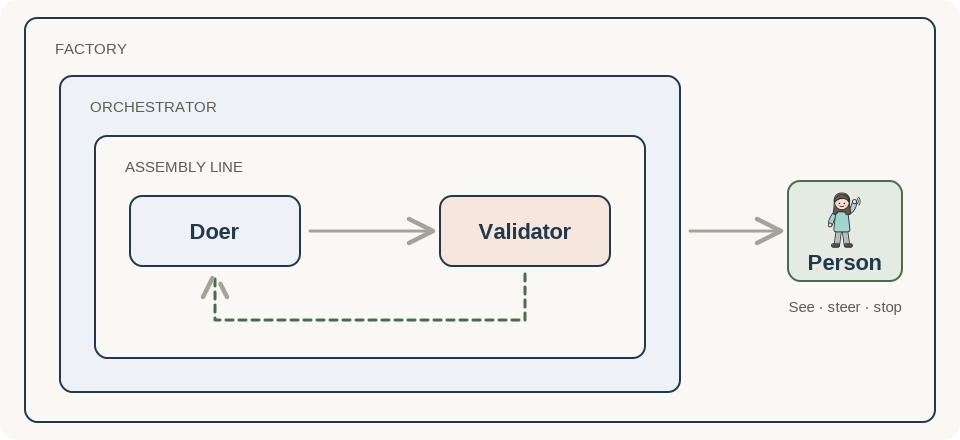
Here’s what that looks like in practice:
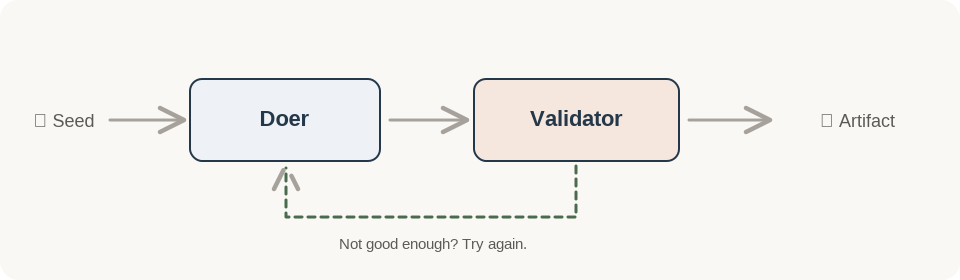
Notice that we’re not committing to what the inputs and outputs of the factory are, because it depends on what the factory is designed to do. A specification that comes out as a new feature is the obvious case, but there are many more, as we’ll explore lower down.
How does this compare with how other people in the industry are talking about it?
The term itself is nearly sixty years old. In Aaen, Bøttcher and Mathiassen’s account, which summarises Michael Cusumano’s history, R. W. Bemer proposed a software factory to General Electric in 1968, and Hitachi was the first company to call a software organisation a factory, in 1969. Back then it meant standardised tools and reuse for human programmers.
If you worked in software in the 2000s, you may remember how Jack Greenfield and Keith Short at Microsoft talked about industrializing software development. In 2004 they described using reusable components and development tools to build families of similar but distinct applications, a step toward mass customization. We’re looking at software factories from the perspective of lean production. Start with a repetitive or wasteful task in your own flow and build in feedback so you can improve how it gets done.
Matt Pocock’s AI Coding Dictionary defines a software factory as “a system of work where triggers, not humans, start agent sessions”. His definition is more linear than ours: it centres on automation and puts less emphasis on validation. His examples do include a loop, where a pull request from one agent triggers an automated review, whose comments trigger a fix-up session. He also makes a point we agree with: a factory “doesn’t have to cover the whole software process”.
Steve Yegge calls Gas Town, the orchestrator he open-sourced in January 2026, “the first-ever software factory”, one where “agents work together autonomously in the background”. It ran dozens of agents in named roles: polecats do the work, a witness watches them, and a refinery merges what they produce. That matches our definition on multiple agents and autonomy. Validation gets less weight: on his site, the description is about those roles and how they are orchestrated, and it doesn’t name validation as part of what makes a factory.
Addy Osmani’s Software Factories, Light and Dark is the closest to our definition. For him a factory is “many harnessed loops running at once, fed by a queue of work”, and he gives validation the same weight we do: “Verification, not generation, is the real constraint on a factory.”
In Birgitta Böckeler’s post on harness engineering, she talks about a “User Harness” or “Outer Harness” as being the layer of deterministic (or Computational) code that wraps around a vendor harness (e.g. Claude Code, Codex, Pi) specifically for your use case and system.
So a factory is a special kind of user harness, one that builds in a validation feedback loop. Why is a validation loop so important?
It’s not a factory if you’re not validating
When an agent says it’s done, you can’t believe it.
In his recent talk Now What?, Justin McCarthy uses the metaphor of injection moulding to explain why validation is so important. Imagine an injection moulding machine without a mould: you’d just spew plastic around the workshop. Validation is the mould that gives the software its useful shape.
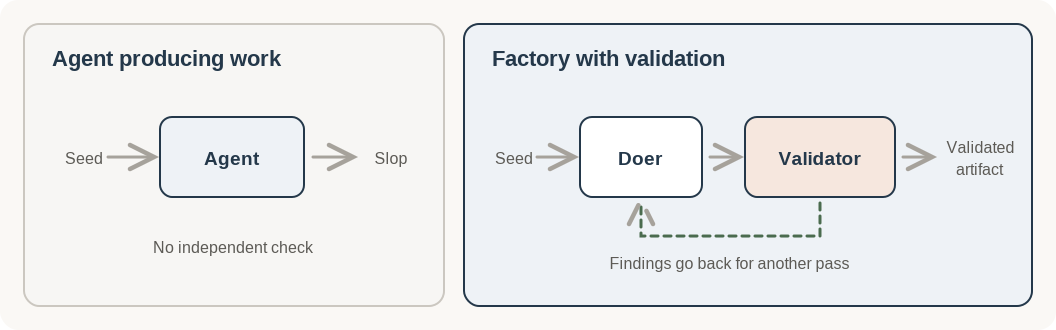
Justin expects the outer loop, including validation, to use roughly 10 to 100 times as many tokens as generating the code itself. The exact ratio will vary, but I think the emphasis is right.
Think of a thermostat. It measures the room temperature, compares it with the setting, and switches the heat on or off. Those repeated checks keep the temperature close to where you want it. An LLM can come up with different answers to the same prompt, and the quality can vary from one attempt to the next. A validator compares each attempt with the criteria for done and sends back what needs fixing. That feedback helps the work converge on the result you want.
Generating code is the easy bit. Generating code that works according to our specifications is harder. Generating code that is well engineered and can be maintained for years to come is hardest of all.
In order to build the kind of sophisticated factory that can produce well-engineered code, we need to step inside the factory and start talking about the elements a software factory is composed of.
Borrowing names from manufacturing
Aldric went looking at how real factories describe their parts. NIST-published manufacturing research distinguishes a factory, production line, workstation, and machine, with different work and information at each level. We’ve taken inspiration from these terms and adapted them to fit the world of software.
Start with a machine
The machine is the fundamental element of a factory. Each machine does one job, and it can be deterministic or non-deterministic:
- A coding agent. A model inside a harness: the code that gives it context and tools, handles its calls, and decides when it has finished.
- A sensor. This is Birgitta Böckeler’s term for something that observes what an agent has done so the work can be corrected. The ones she calls computational sensors, such as a linter or a test suite, are deterministic code with no model in them.
- A mix of the two. Very often a machine is an LLM that does little more than call a deterministic script and manage the calls.
Machines play different roles in your factory. Two very typical ones are the doer and the validator.
Give machines different jobs
The doer makes something. The validator checks it against the criteria for done, then sends findings back if it needs another pass.
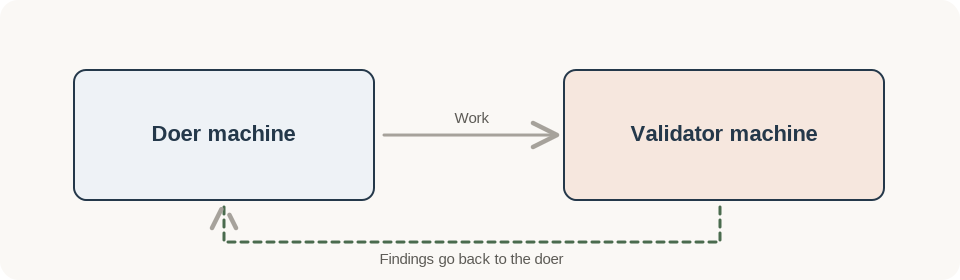
I like using a separate validator because the model that has just done the work has spent its context window making those decisions. A fresh check can spot different problems.
Connect them in an assembly line
An assembly line takes an input, which we call a seed, and produces an artifact. The line sets the order of the jobs. It might branch, run several checks, or send failed work back around the loop.
In this one, three validators check the doer’s work in parallel and a synthesizer combines their findings:
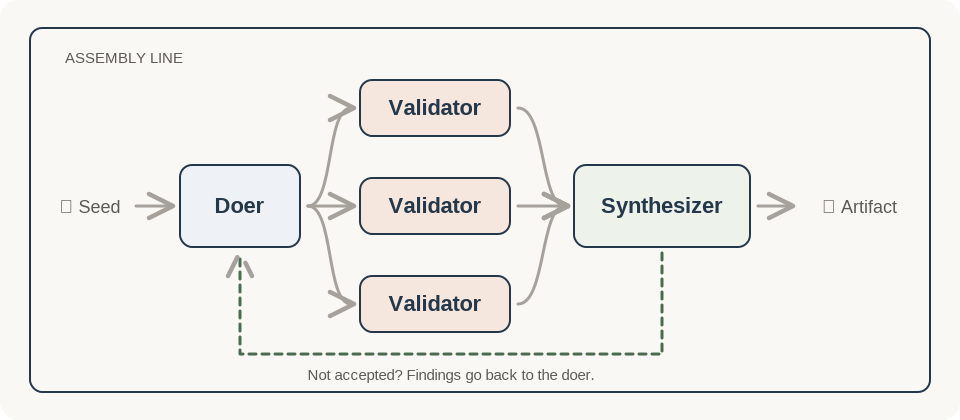
To learn more about this technique, see our lightning lesson, Three Big Brains.
Why do we need to distinguish between an assembly line and a factory? Often they are the same thing, but in a sophisticated setup, a factory can be composed of multiple assembly lines, where the artifact of one feeds in as the seed to another.
Run the line as a factory
An orchestrator starts the line, passes work between machines, handles failures, and knows when a run is finished. The orchestrator also gives people visibility into the token cost, controls to stop or steer a run, and detail about how a run is progressing.
All this combines into the larger system we call a factory.
Now that we have names for these parts, what kind of work can you give to a factory?
A factory is not just for features
It’s easy to conflate “Software Factory” with Feature Factory. This is what most people think of when they hear the term.
But there are all kinds of software engineering tasks LLMs can allow us to automate that don’t involve generating new features:
- Dealing with flickering tests
- Upgrading dependencies
- Horizontal refactorings to apply a pattern consistently across a codebase
- Improving linter rules based on code review findings
As Navan Chauhan, part of the team at StrongDM, points out, these kinds of more modest LLM automations are almost always the best place to start. In our experience, it’s much better to build your factory from the bottom up, by continuously automating the most repetitive or wasteful tasks in your flow.
Until you’ve cleaned up your codebase, it’s over-ambitious to expect a factory to turn Jira tickets into working features autonomously. Lauren Tan says something similar in her talk All Code Is Slop (Except Mine): improve your codebase and your validation before you build a factory, because “if your inner coding loop produces slop, then automating that loop just produces more slop”.
How dark is a software factory?
Each assembly line is dark: it runs autonomously. In that way, it becomes a power tool that we humans can use at will. We can also assemble them into larger, more sophisticated assembly lines, but at some point you’re always going to need human involvement.
Dan Shapiro’s The Five Levels: from Spicy Autocomplete to the Dark Factory is a scale of how involved a person is, with the dark factory at the far end. Aldric makes the case for keeping human judgment in the work in The Dark Software Factory Is a Lie.
I hope this language is useful for engineering your own software factories. A factory can begin with one doer and one validator working on a small job. What piece of work do you repeat often enough, and understand well enough, to try that with?
And if you want to learn more, here are some resources.
- What Is a Software Factory? lightning lesson
- Build a Software Factory course. The self-paced course is available now. The next live cohort starts in January.